


Beginner Table Game Strategy for Smarter First Sessions
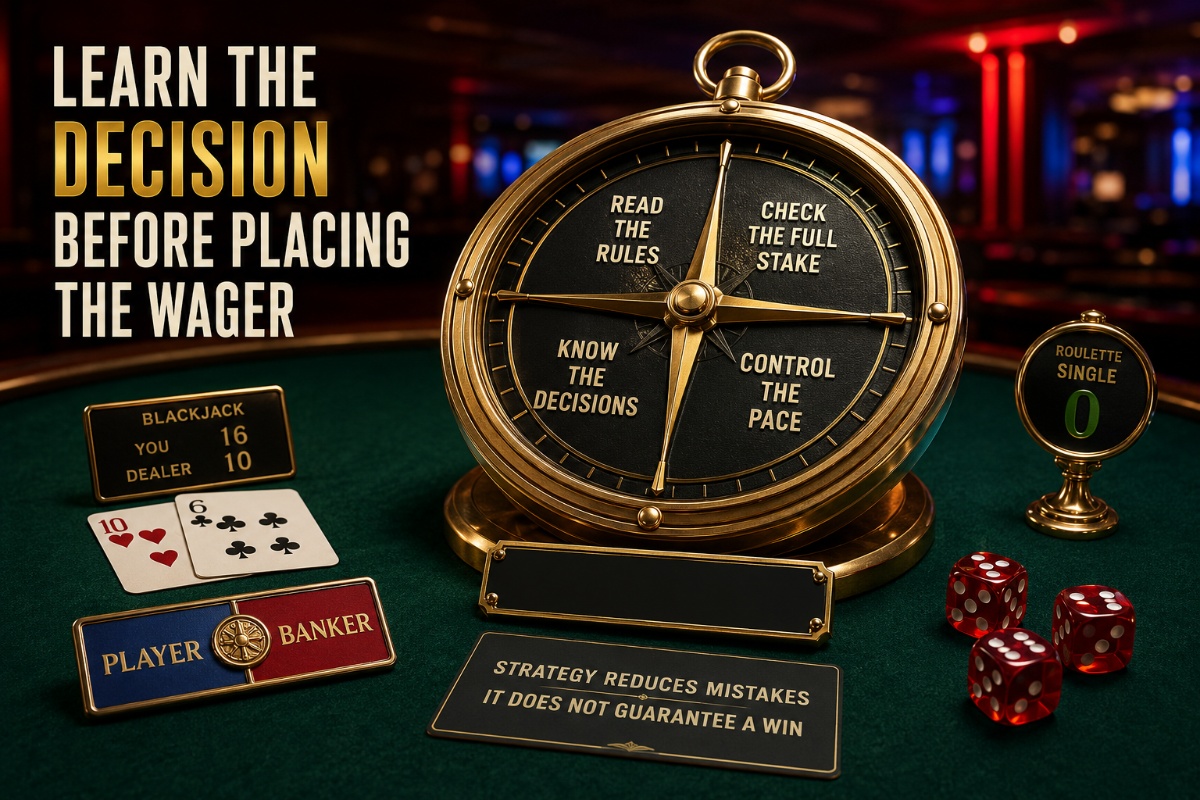
Table game strategy for beginners should begin with understanding the rules rather than choosing a betting progression. Blackjack, baccarat, roulette, Sic Bo, and poker-style games use different decisions, payouts, and round costs. A useful strategy reduces preventable mistakes, identifies the full amount that could be committed, and keeps the pace manageable. It cannot guarantee a winning session or remove the house edge built into the game.
Beginner table game strategy at a glance
| Strategy check | Why it matters |
|---|---|
| Read the active rules | Similar game names can use different payouts and procedures |
| Learn the main wager | Side bets should not distract from the central game |
| Identify every decision | Later actions can change both strategy and cost |
| Calculate full exposure | The table minimum may be only the opening wager |
| Control round speed | Faster play produces more wagering opportunities |
Strategy begins with the exact game version
One broad game name can cover several versions. Blackjack tables can differ in deck count, natural payout, dealer soft-17 rule, surrender, splitting, and doubling. Roulette can use one, two, or more green pockets. Baccarat can apply commission or a special reduced Banker payout.
Singapore’s Gambling Regulatory Authority maintains separate approved rules for multiple table games and variations, which demonstrates why the complete title matters. A strategy taken from one version may not fit another.
Open the information panel and identify the provider, format, paytable, limits, and special conditions before using any chart or recommendation.
Choose the main wager before considering extras
Table game strategy becomes harder to manage when several optional markets are added immediately. First understand the central wager:
- Blackjack: Build a hand that beats the dealer without exceeding 21.
- Baccarat: Back Player, Banker, or Tie.
- Roulette: Cover one pocket or a defined group of pockets.
- Sic Bo: Predict a result from three dice.
- Casino Hold’em: Continue or fold after evaluating the hand and board.
Side bets use separate conditions and usually have separate payouts. They should be evaluated only after the main game is clear.
Match the game to the preferred decision load
Not every beginner wants the same level of involvement. Baccarat, roulette, Dragon Tiger, and Sic Bo generally require the main choice before betting closes. The result is then settled automatically.
Blackjack requires repeated decisions such as hit, stand, double, split, or surrender. Casino Hold’em can require a Fold or Call decision after the flop.
A practical decision-first game plan starts with a format whose available choices can be explained before money is committed.
Blackjack needs rule-based decisions
Blackjack is one of the few common casino table games where player decisions materially affect the expected return. The correct action depends on the player total, dealer upcard, and active rules.
A basic-strategy chart should match the exact table. A chart designed for a dealer who stands on soft 17 may not provide the same recommendations when the dealer hits soft 17. Deck count and surrender rules can also change selected decisions.
The approved Singapore blackjack rules define the objective as reaching 21 without exceeding it or finishing closer to 21 than the dealer. The available actions and settlement still depend on the particular version.
Do not improvise blackjack from recent hands
A dealer drawing several low cards does not make another low card more likely on the next hand. A recent series of dealer blackjacks does not justify abandoning the applicable strategy chart.
Table game strategy in blackjack should be based on the current hand and rules, not visual streaks. Previous rounds can be useful for checking settlement but do not replace the decision framework.
Insurance is also a separate wager on the dealer having blackjack. It should not be treated as free protection for a weak hand.
Baccarat has fewer decisions but several prices
Baccarat does not ask the bettor whether Player or Banker should draw another card. The drawing procedure is compulsory. The strategic choice is therefore concentrated in market selection, table version, stake, and optional wagers.
Player commonly pays 1:1. Traditional Banker commonly pays 0.95:1 after commission, while Tie and pair bets offer larger payouts for narrower conditions.
The previous guide to baccarat payouts explains those returns, commission calculations, pair settlements, and no-commission exceptions in detail.
Roadmaps do not create baccarat predictions
Bead Plates and Big Roads organise completed Banker, Player, and Tie results. Derived roads describe patterns within the recorded chart.
They do not alter the cards remaining in the shoe or make one side due. A long Banker run can continue, reverse, or move into a Tie. None of those outcomes is guaranteed by the visual pattern.
A sensible baccarat approach uses roadmaps as historical displays rather than betting signals that promise the next result.
Roulette strategy starts with the wheel
Before selecting red, black, a dozen, or a number, identify the wheel format. A standard single-zero wheel has 37 pockets. A double-zero wheel has 38 while usually retaining the familiar payouts.
The extra green pocket increases the standard mathematical disadvantage. When equivalent games and payouts are available, the wheel with fewer green pockets generally offers the lower house edge.
Approved roulette rules list straight-up, split, street, corner, six-line, column, dozen, and even-money wagers as separate betting categories.
Coverage and payout move in opposite directions
A straight-up roulette bet covers one pocket and commonly pays 35:1. Red or black covers 18 pockets and commonly pays 1:1.
Covering more numbers increases the frequency with which one selected area can win, but the payout falls. Adding chips to several areas also raises the total cost of the spin.
A beginner should inspect the complete chip placement instead of judging the wager from one unit value.
Roulette systems do not change the wheel
Martingale, Fibonacci, D’Alembert, and colour-streak methods change the amount or order of wagers. They do not remove zero, alter the payout, or make the next colour more likely.
Starting at S$5 and doubling after four losses creates:
S$5 + S$10 + S$20 + S$40 + S$80 = S$155 total exposure
Table limits or another loss can stop the progression before any recovery. Increasing the stake is not the same as improving the probability.
Sic Bo requires market-by-market reading
Sic Bo offers Big, Small, Odd, Even, totals, combinations, single numbers, doubles, and triples. Broad markets commonly pay less because more dice outcomes qualify. Specific triples offer larger payouts because only one exact result wins.
Big and Small can also exclude any triple, even when the numerical total falls inside the expected range. That exception should be confirmed in the active rules.
The approved Singapore Sic Bo rules treat the available dice markets and payouts as separate betting conditions rather than one general wager.
Larger payouts do not automatically offer better value
A 30:1 or 150:1 payout attracts attention, but the number is connected to a less frequent event. The full comparison requires both probability and payout.
Table game strategy should therefore avoid treating a large prize as evidence that the wager is stronger. Read the complete paytable, including lower categories, excluded outcomes, and maximum awards.
The largest figure may apply to only one exact card, dice, or poker combination.
Calculate the most expensive possible round
The table minimum may refer only to the first wager. Blackjack doubles and splits require additional stakes. Casino Hold’em can require a Call worth more than the Ante. Roulette sector buttons can distribute several chips.
Consider a blackjack round with a S$10 opening wager, one split, and one double:
S$10 opening bet + S$10 split + S$10 double = S$30 exposure
A full-round stake check provides a more realistic plan than multiplying the lobby minimum alone.
Side bets change the complete strategy
A S$10 main wager with two S$2 optional bets creates S$14 of opening exposure:
S$10 + S$2 + S$2 = S$14
The main wager can win while both side bets lose. In that example, a S$10 even-money main win combined with S$4 in side-bet losses produces only S$6 net profit.
Table game strategy should account for all accepted areas rather than celebrating one successful component of the round.
Set a normal stake before joining the table
The maximum displayed by the game is an operating limit, not a recommended amount. A table accepting S$500 does not make S$500 an appropriate wager for every player.
Choose a normal stake that leaves room for legitimate later decisions. A blackjack player who can afford only the opening bet may be unable to split or double when the chosen strategy calls for it.
The planned stake should also include optional markets only when they have been deliberately selected.
Round speed affects total turnover
A S$5 wager repeated for 20 rounds creates S$100 in turnover:
S$5 × 20 = S$100
The same wager repeated for 60 fast rounds creates S$300:
S$5 × 60 = S$300
These figures are wagering volume, not predicted losses. Faster live tables, electronic games, and RNG modes simply create more opportunities to place another bet.
Use the timer instead of racing it
A shared live betting window can create pressure to repeat a wager before the current amount and market have been checked. Missing a round costs nothing.
Before confirming, verify:
- The selected market
- The stake
- The complete round exposure
- Any side bets
- The currency or credit value
A good table game strategy allows enough time to understand each action rather than treating speed as a requirement.
Keep game records for settlement questions
When a result appears incorrect, save the complete game title, round reference, accepted stake, cards or wheel result, selected market, and final credit.
A roadmap, animation, or dealer announcement may help identify the round, but the transaction history is usually the stronger settlement reference.
Do not repeat the wager immediately because the balance has not updated. First confirm whether the previous round was accepted and resolved.
A strategy cannot guarantee a positive result
The UK Gambling Commission describes roulette, blackjack, and punto banco as games in which the house retains an average mathematical advantage under normal play.
Blackjack decision strategy can reduce avoidable errors, while choosing a single-zero roulette wheel or understanding baccarat pricing can reduce unnecessary disadvantage. None of these steps guarantees that one session will finish ahead.
Responsible strategy improves decision quality rather than claiming control over random results.
Applying table game strategy on Gembet
Gembet may display several providers and versions of the same game family. Availability, limits, paytables, and side bets can change, so use the active interface as the final reference.
- Open the complete rules and paytable.
- Identify the main objective and wager.
- List every decision required after the opening bet.
- Check the house edge or RTP information where displayed.
- Calculate the maximum plausible completed-round cost.
- Separate main wagers from side bets.
- Choose a pace that allows every action to be checked.
- Use the transaction history for settlement reviews.
Building a practical beginner approach
Table game strategy for beginners is not a secret betting pattern. It is a repeatable process for understanding the exact version, selecting the main wager, preparing for later decisions, and controlling total exposure.
Use a decision-first game plan for blackjack and poker-style games. Complete a full-round stake check whenever splits, doubles, Calls, side bets, or multi-chip selections can increase the cost.
Table game strategy works best as error prevention. Learn the rules, compare the active paytable, avoid chasing previous results, and recognise that even a well-informed wager can still lose.
Experience the real deal with SG's top Live Dealers. Play Baccarat, Roulette & more.

