


Slot Hit Frequency and What a Winning Spin Really Means
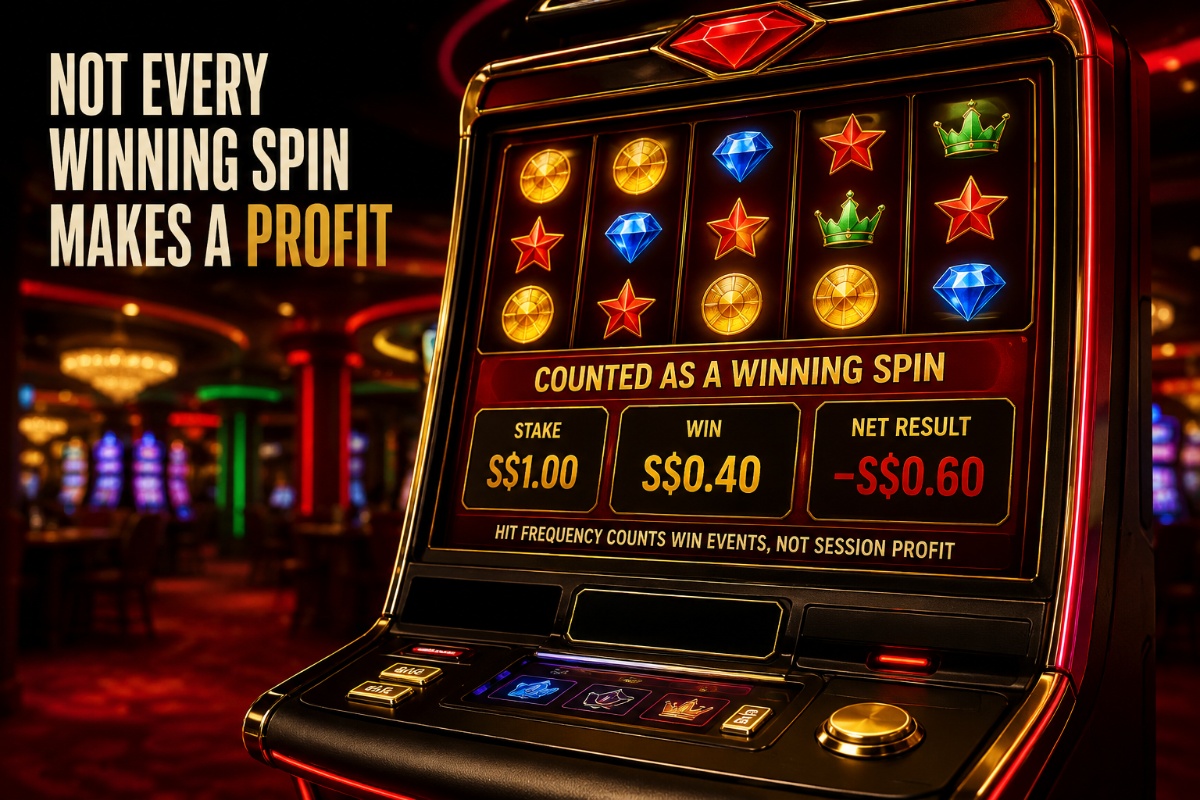
Slot hit frequency describes how often a spin produces a result that the game records as a win. It does not necessarily show how often the player earns a net profit. A S$1 spin returning S$0.40 can trigger a winning animation and count towards the hit rate even though the balance falls by S$0.60. Hit frequency must therefore be read alongside payout size, RTP, volatility, bonus mechanics, and total wagering volume.
Slot hit frequency in one quick comparison
| Measurement | What it describes |
|---|---|
| Hit frequency | How often a spin records a qualifying win |
| Net-positive spin rate | How often the total return exceeds the stake |
| RTP | The theoretical percentage returned over extensive play |
| Volatility | How widely and unevenly prizes are distributed |
| Bonus frequency | How often a specific feature is expected to trigger |
What counts as a winning spin?
A slot normally records a win when one or more qualifying combinations produce a payout under the active paytable. The return can be smaller than, equal to, or larger than the amount wagered.
Suppose a spin costs S$1 and returns S$0.40:
S$0.40 return − S$1 stake = −S$0.60 net result
The game can still classify that round as a hit because it awarded a prize. This distinction is essential when interpreting slot hit frequency or watching frequent win animations.
Winning spins and profitable spins are different
A profitable spin returns more than the original stake. A break-even spin returns exactly the stake. A partial return pays something but still reduces the balance.
| S$1 spin return | Classification | Balance effect |
|---|---|---|
| S$0 | No recorded win | −S$1 |
| S$0.40 | Winning spin or partial return | −S$0.60 |
| S$1 | Winning spin and break-even result | S$0 |
| S$3 | Winning and profitable spin | +S$2 |
The net-positive spin rate is therefore usually lower than the overall hit rate when partial returns are included.
How slot hit frequency is calculated
The basic calculation divides the number of recorded winning spins by the total number of completed spins.
If a fictional game records 24 wins across 100 spins:
24 ÷ 100 × 100 = 24% hit frequency
This figure does not state the value of those 24 prizes. They could include several returns below the stake, a few break-even results, and one larger payout.
A complete interpretation therefore requires both frequency and prize distribution.
A higher hit rate does not guarantee a higher RTP
Slot hit frequency and RTP measure different parts of the game. One title can produce frequent small prizes, while another produces fewer but larger prizes. Both can theoretically return the same percentage across extensive play.
Consider two fictional games with 96% theoretical RTP:
- Game A records a 30% hit rate using many modest returns.
- Game B records a 15% hit rate with fewer, larger prizes.
These percentages are illustrative, but they show why a high winning-spin percentage does not prove that the game returns more money overall.
The UK Gambling Commission explains that RTP is an average measured across a significant number of plays rather than a return achieved during every session. :contentReference[oaicite:0]{index=0}
Volatility changes the size and distribution of wins
A low-volatility game commonly uses smaller, more frequent prizes. A high-volatility title may contain larger but rarer outcomes and wider short-term swings.
The UK Gambling Commission describes volatility through standard deviation and notes that high-volatility games can contain prizes in the “very large but rare” category. Lower-volatility games tend to rely more heavily on smaller, frequent prizes. :contentReference[oaicite:1]{index=1}
This does not mean every low-volatility game has a higher slot hit frequency. Providers can structure partial returns, features, and prize categories differently.
The internal casino volatility guide explains how prize distribution shapes short-session balance movement.
Hit frequency does not reveal average win size
Two slots can record the same number of winning spins while returning different total amounts.
Imagine that each fictional game records 20 wins across 100 S$1 spins:
- Game A awards an average of S$1.20 across its winning spins.
- Game B awards an average of S$4.00 across its winning spins.
Both display a 20% hit rate, but their total returns differ substantially. The paytable, feature contribution, and prize size determine the rest of the result.
Bonus frequency is a separate measurement
A bonus trigger is one type of qualifying event. It should not be treated as the same figure as slot hit frequency.
A spin may form a normal line or cluster win without activating free spins. Another spin may trigger a feature through scatter symbols while also paying a separate scatter prize.
Bonus frequency asks how often the specific feature starts. Hit rate asks how often any eligible win is recorded under the game’s rules.
A feature can also award a weak result, so triggering the bonus does not guarantee that the completed round becomes profitable.
Paylines affect how wins are counted
In a payline slot, symbols normally need to appear on an active line and follow the required direction or sequence. Several paylines can win during one spin.
That spin still counts as one winning spin, not one hit for every successful line, when calculating the normal winning-spin percentage.
The value of all qualifying lines is added to form the total return. A game with many lines can therefore display several small simultaneous wins without producing a net-positive result.
Ways-to-win games remove fixed paylines
Ways-to-win slots commonly award matching symbols on consecutive reels without requiring a fixed drawn line. Expanding reels can increase the number of possible symbol combinations.
More potential ways do not automatically establish a higher slot hit frequency. Symbol distribution, reel strips, minimum match length, wild behaviour, and payout values still control the mathematics.
The displayed number of ways describes possible winning arrangements, not the expected number of successful spins.
Cluster games use another qualifying method
Cluster-pays titles usually require matching symbols to touch horizontally, vertically, or through another stated connection rule.
A large grid may create many possible clusters, but the required cluster size can offset that additional space. Wilds, blockers, multipliers, and symbol removal can further change the result pattern.
Read the cluster requirement and symbol paytable rather than assuming that a larger board guarantees frequent wins.
Cascades complicate the definition of one spin
A cascading game removes winning symbols and drops new ones into the vacant positions. One paid spin can produce several consecutive wins before the cascade ends.
For standard session counting, the initial paid action is usually one spin even when it creates multiple cascades. Providers may separately report cascade events for internal analysis.
Slot hit frequency should therefore be checked against the provider’s stated definition. Counting every cascade as another paid spin can inflate a personal estimate.
Free spins can use different result behaviour
During free spins, multipliers, expanding symbols, sticky wilds, or different reel strips may alter the apparent payout frequency.
The feature’s results still contribute to the game’s overall mathematical model, but a short bonus does not reveal the long-run rate. One feature may contain repeated small wins, while another contains several blank spins and one larger result.
Do not calculate a game-wide hit rate from one bonus round.
Dead spins are simply rounds without a payout
Players often use “dead spin” to describe a round that produces no recorded monetary return. A sequence of dead spins can occur in games with either low or high theoretical RTP.
A high number of recent dead spins does not make a winning combination due. Random games do not need to compensate one account immediately because its recent results were weak.
The UK Gambling Commission states that prize amount and frequency in random gaming machines remain determined by chance. :contentReference[oaicite:2]{index=2}
A short sample produces an unstable estimate
Suppose a player records 5 wins in 20 spins:
5 ÷ 20 × 100 = 25%
After another 80 spins, the full record may contain only 16 wins:
16 ÷ 100 × 100 = 16%
Neither sample necessarily reveals the designed slot hit frequency. Random clustering can push a limited observation above or below the long-run expectation.
The regulator also notes that game volatility affects how far actual results can vary from theoretical performance during limited play. :contentReference[oaicite:3]{index=3}
Round speed multiplies exposure
A title with frequent small returns can feel active, encouraging faster repeated play. Turbo modes, autoplay, quick-spin controls, and short animations increase the number of wagers completed during the same period.
At S$1 per spin:
50 spins = S$50 turnover
200 spins = S$200 turnover
Turnover includes reinvested winnings as well as new money added to the game. The UK Gambling Commission defines turnover as the total of all stakes, including winnings wagered again. :contentReference[oaicite:4]{index=4}
Win animations can make partial returns feel larger
Sound effects, flashing symbols, coin animations, and celebratory messages can appear whenever the game records a qualifying payout.
The presentation does not determine whether the balance increased. Compare the total return with the complete spin cost:
Net result = total return − total stake
When several paylines, ante bets, or feature options are active, use the complete wager rather than the base coin value.
Different versions may use different hit rates
A familiar slot title can appear with alternative RTP settings, paytables, feature-purchase options, jackpot components, or reel configurations.
Those changes can affect prize frequency, average prize size, volatility, or feature behaviour. A statistic published for one configuration should not automatically be applied to another.
Use the exact provider, game title, currency mode, and current information panel when comparing versions.
Checking slot hit frequency on Gembet
Gembet may display games with different mechanics and provider disclosures. Hit-rate information is not always published, so avoid inventing a percentage from a short demo session.
- Open the complete game information and paytable.
- Check whether the provider publishes a hit rate.
- Identify whether partial returns count as wins.
- Separate ordinary hit rate from bonus frequency.
- Review RTP and volatility independently.
- Confirm how cascades and free spins are counted.
- Compare the complete stake with each total return.
- Use a large sample cautiously if recording results manually.
Using slot hit frequency correctly
Slot hit frequency shows how often a game records a qualifying winning event. It does not state how often the balance rises, how much an average win pays, or whether a bonus will trigger soon.
A high slot hit frequency can include many returns below the original stake. A lower rate can coexist with larger average prizes. RTP measures theoretical long-run return, while volatility describes the distribution of those outcomes.
Use hit rate together with the paytable, average prize structure, bonus rules, stake, and round speed. The most useful figure is not simply how often the reels celebrate, but how the total return compares with the complete cost of the spin.
High RTP slots with instant 100% Welcome Bonus. Spin & Win big today!

