


Sic Bo Payouts Explained With 8 Critical Checks
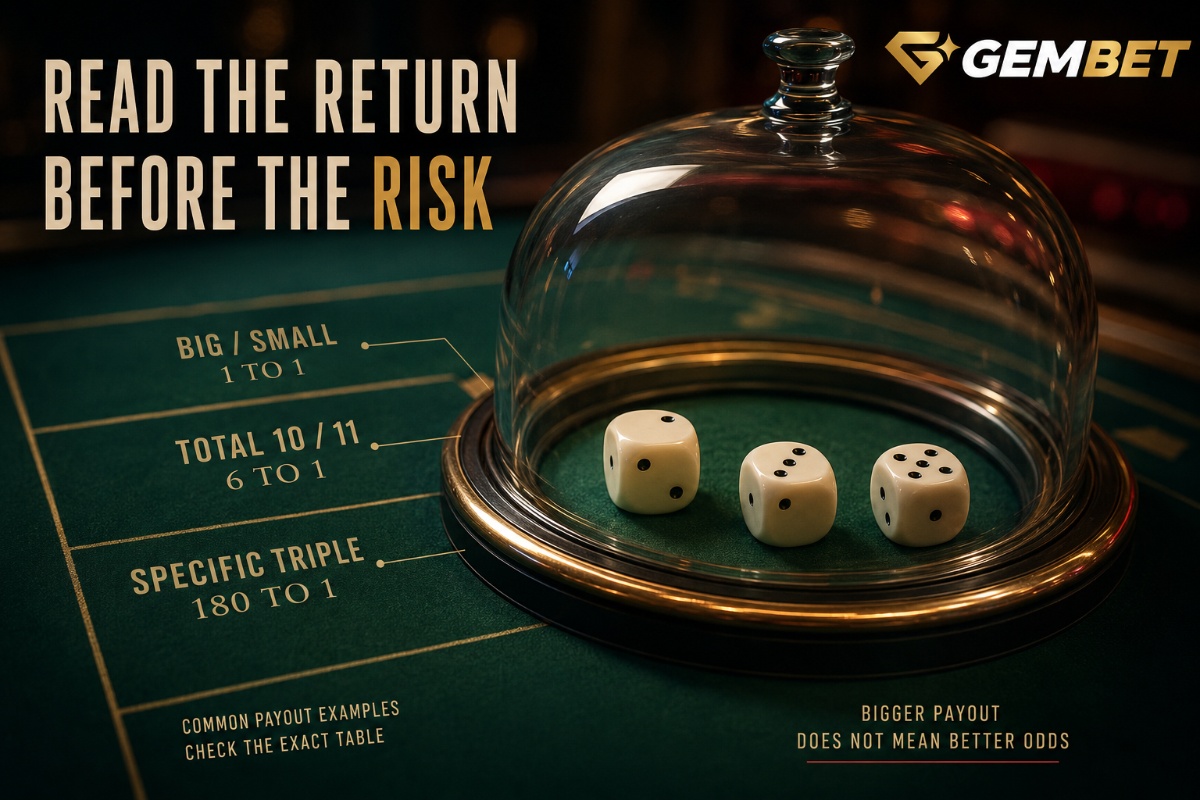
Sic Bo payouts tell you how much a winning three-dice selection returns, but the biggest number on the table is not automatically the best-value wager. Different outcomes have different probabilities, and the casino payout is normally lower than the mathematically fair return. That gap creates the house edge. For Gembet users, the useful approach is to read Sic Bo payouts together with the exact bet condition, because Big, Small, totals, combinations and triples can use different return structures.
What Sic Bo payouts actually show
Sic Bo payouts describe the return attached to a winning selection. They do not describe how likely that selection is to happen. A Big wager may pay 1 to 1, while a specific triple can show a much larger return, but the triple also occurs far less often. Three fair six-sided dice create 216 ordered outcomes, so probability can be calculated from how many of those outcomes satisfy the wager.
This distinction is the foundation of reading the table. A payout is the reward offered. Probability is the chance of the dice producing the required result. House edge appears when the offered return is lower than the fair return implied by that probability.
Common Sic Bo payouts are not universal
Published tables often show familiar figures, but exact Sic Bo payouts can vary by casino, provider or game variant. A common reference structure pays Big and Small at 1 to 1, a two-number combination at 6 to 1, any triple at around 30 to 1 and a specific triple at around 180 to 1.
| Example wager | Common example payout | Why it differs |
|---|---|---|
| Big or Small | 1 to 1 | Many qualifying combinations |
| Two-number combination | 6 to 1 | Both selected faces must appear |
| Any Triple | About 30 to 1 | Only six triple outcomes |
| Specific Triple | About 180 to 1 | Only one exact triple outcome |
| Total 10 or 11 | Often around 6 to 1 | More combinations than an extreme total |
Use those figures as examples, not a promise. The displayed Sic Bo payouts on the game are what matter for settlement.
How Big and Small payouts compare with probability
Under standard Dai Siu rules, Small covers totals 4 through 10 and Big covers 11 through 17, with triples excluded. Each side has 105 winning ordered combinations out of 216, or approximately 48.61% probability.
At a 1-to-1 payout, a SGD 20 winning stake normally produces SGD 20 profit plus the SGD 20 stake returned, for SGD 40 total return. Because 105 of 216 outcomes win rather than exactly half, these Sic Bo payouts produce a house edge of about 2.78% under that standard rule set.
Why exact totals have different Sic Bo payouts
Three dice can make middle totals in many more ways than extreme totals. A total of 10 has 27 ordered combinations out of 216, or 12.5% probability. Totals such as 4 or 17 have only three ordered combinations each. This is why Sic Bo payouts for exact totals generally rise as the selected sum becomes harder to produce.
If a total of 10 pays 6 to 1, a SGD 10 winning stake produces SGD 60 profit plus the original SGD 10 stake, for SGD 70 total return. The payout should still be compared with the underlying probability rather than judged by the headline number alone.
The difference between 6 to 1 and a 7x return
A payout written as 6 to 1 usually means six units of profit for every one unit staked, with the original stake returned. That makes the total return seven units. Some digital games instead display a multiplier that already includes the stake.
Before calculating Sic Bo payouts, check whether the table is showing profit odds, total-return multipliers or another notation. Do not assume that “6:1” and “6x” always mean the same thing.
Specific triple payouts look large for a reason
A specific triple means naming one exact matching result such as 4-4-4. There is only one ordered outcome for that exact triple among 216 possible outcomes, giving a probability of about 0.46%. Traditional Sic Bo payouts can quote around 180 to 1 for a specific triple, although tables vary.
At 180 to 1, a SGD 5 winning stake would produce SGD 900 profit plus the SGD 5 stake returned. Under that example payout, the mathematical house edge is about 16.20%, so the large headline amount should not be mistaken for better long-run value.
Any Triple covers more outcomes
An Any Triple wager wins when all three dice match, regardless of the number. There are six such ordered outcomes from 216, or about 2.78% probability. Because the wager covers six times as many outcomes as one specific triple, its Sic Bo payouts are normally much smaller. A common reference figure is around 30 to 1, but the exact table should always be checked.
Single-number payouts can change with multiple matches
A single-number wager selects one face, such as 5, and wins when that number appears on at least one die under standard rules. Some tables increase the return if the selected number appears on two or all three dice.
This means Sic Bo payouts for a single-number selection cannot always be summarised by one figure. One occurrence, two occurrences and three occurrences may each have their own return.
Eight checks before comparing Sic Bo payouts
- Identify the exact wager. Big, Small, total, combination, double and triple selections have different conditions.
- Check whether the figure is profit or total return. Payout notation is not always presented the same way.
- Read the triple exception. Standard Big, Small, Odd and Even commonly lose when all three dice match.
- Compare probability with payout. A larger return usually comes with a less frequent outcome.
- Check the exact table. Sic Bo payouts can vary between versions and providers.
- Do not copy a payout chart from another casino. Similar layouts do not guarantee identical returns.
- Use a fixed stake. A rare high-payout result is not a reason to risk more than planned.
- Ignore previous rolls as predictions. Earlier results do not change the probability of the next independent roll.
Why house edge matters more than the biggest payout
House edge measures the casino’s mathematical advantage over repeated wagers. It does not predict one round. A lower-edge bet can lose, while a higher-edge longshot can still win once.
If two tables use the same winning probability but one pays less for the same result, the lower-paying version gives a worse mathematical return.
Dai Siu payouts and the triple exception
Dai Siu is another name associated with Big and Small. Under the standard version, 4-4-4 totals 12, which sits numerically inside the Big range. However, the triple exception means a normal Big wager loses. The payout rule therefore depends on both the total and the dice pattern.
This matters when reading Sic Bo payouts because simply adding the dice is not enough for every market. Always check whether the selection contains an exclusion.
Do multipliers change the basic payout logic?
Some modern variants add multipliers or enhanced returns to selected outcomes. These features can make Sic Bo payouts look different from a traditional table. They do not make the underlying outcome certain. The multiplier applies only when the relevant selection wins.
Do not transfer a standard payout table into a multiplier version or assume an enhanced number is available every round.
How to calculate a Sic Bo payout before wagering
If the table quotes profit odds in “to 1” format, multiply the stake by the quoted number to find the profit, then add the returned stake. For example, SGD 10 at 6 to 1 gives SGD 60 profit and SGD 70 total return. SGD 20 at 1 to 1 gives SGD 20 profit and SGD 40 total return.
These calculations make Sic Bo payouts easier to compare, but they say nothing about whether the dice will produce the required result.
Check the exact Gembet table information
Where Sic Bo or Dai Siu is available in the current Gembet catalogue, use the in-game information for the exact table. Gembet’s live-casino menu can provide game rules, bet descriptions, special conditions, RTP information and recent history where supported.
This matters because Sic Bo payouts can change across providers and variants. A familiar Big/Small layout does not prove that every total, combination or triple uses the same return seen elsewhere.
Read Sic Bo payouts as part of the rules
Sic Bo payouts are part of the mathematical rules of the game. To understand a wager properly, identify how many outcomes can win, what the table pays when one of them occurs and whether special exclusions apply.
The simplest bets can have modest returns because many dice combinations qualify. Rare exact totals and triples can display much larger returns because far fewer outcomes win. Neither structure guarantees a better short-term result.
Before comparing Sic Bo payouts, check the wager condition, payout notation, triple rules and exact table return. That approach makes the payout table easier to understand without turning a game of chance into a prediction system.
Experience the real deal with SG's top Live Dealers. Play Baccarat, Roulette & more.

