


Roulette Betting Mistakes That Cost More Than Expected
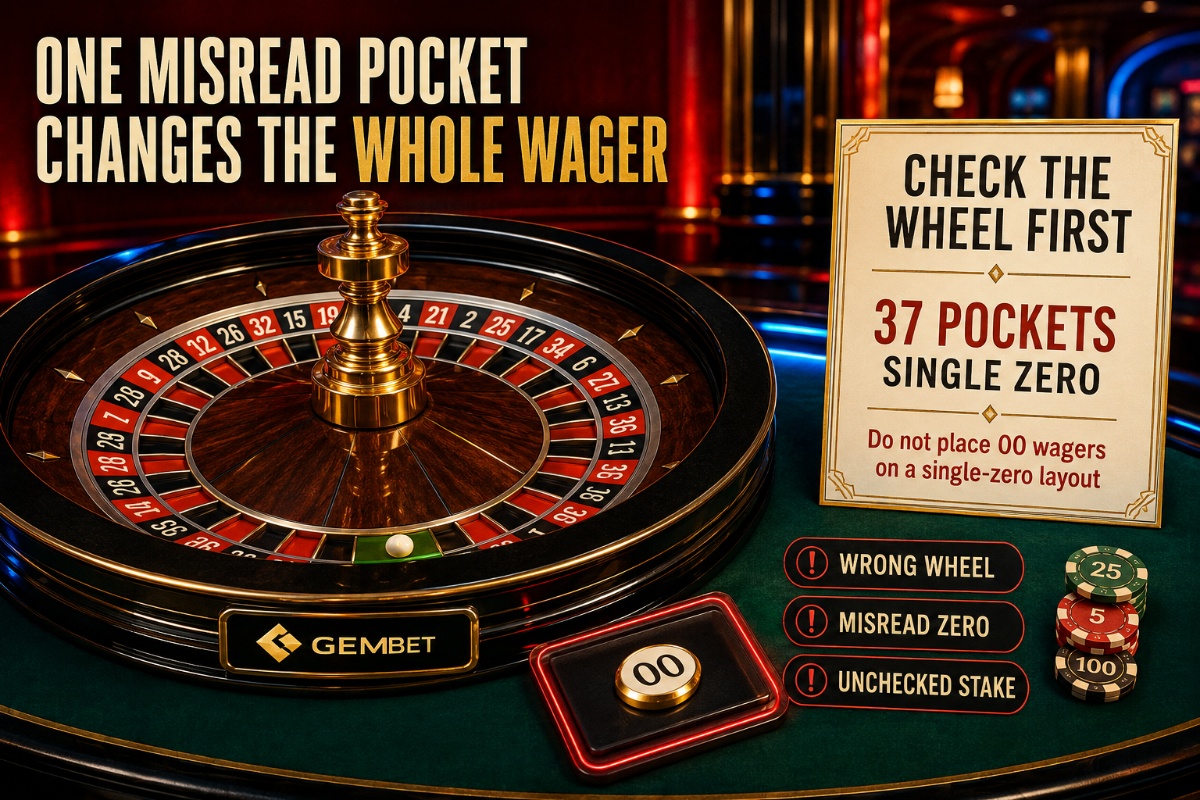
Roulette betting mistakes often begin before the wheel starts moving. A player may select the wrong version, overlook a green pocket, misread a multi-chip wager, or assume that a recent streak changes the next result. These errors do not merely affect presentation. They can increase the complete stake, weaken the selected payout, or create exposure that was never included in the session plan.
The costly mistakes in one view
| Mistake | What it changes |
|---|---|
| Ignoring the wheel type | The number of possible outcomes and standard house edge |
| Calling red or black 50-50 | The effect of zero and double zero |
| Confusing coverage with value | Hit frequency without improving the standard price |
| Overlapping several wagers | The total amount committed per spin |
| Chasing recent results | Stake size without changing the next outcome |
Mistake 1: Choosing from the table colour
One of the most basic roulette betting mistakes is assuming that every familiar layout uses the same wheel. European roulette normally has 37 pockets: numbers 1–36 and one zero. American roulette adds 00, bringing the total to 38.
Evolution’s official catalogue distinguishes its single-zero European version from American Roulette, which includes both 0 and 00. Singapore’s regulator also publishes separate approved rules for single-zero and double-zero roulette formats.
The felt colour, dealer presentation, and studio design do not identify the mathematics. Count the green pockets before placing the first chip.
Mistake 2: Treating even-money bets as true 50-50 wagers
Red and black each cover 18 numbered pockets. Odd and even also cover 18, as do high and low. The remaining green pocket prevents these selections from being genuine 50-50 propositions.
On a single-zero wheel, a red wager has 18 winning pockets and 19 losing pockets. On a double-zero wheel, it has 18 winning pockets and 20 losing pockets.
The standard payout commonly remains 1:1. Ignoring the green outcomes is a wheel-version mistake, not a minor visual oversight.
Mistake 3: Assuming more coverage means better value
A straight-up bet covers one number and commonly pays 35:1. A dozen covers 12 numbers and commonly pays 2:1. Red or black covers 18 numbers and commonly pays 1:1.
Wider coverage increases the number of pockets that can produce a winning result, but the payout declines. Under conventional single-zero rules, ordinary inside and outside wagers are structured around the same standard house edge.
Coverage changes hit frequency and payout size. It does not automatically improve the mathematical price.
Mistake 4: Forgetting that zero belongs to no outside group
Zero is green. It is not red, black, odd, even, low, high, part of a dozen, or part of a column. Double zero is also excluded from those groups.
This can be misunderstood when a player treats zero as even in the mathematical sense or assumes it belongs below 1 in the low range. Roulette settlement uses the categories printed in the rules, not ordinary number theory.
The previous article on roulette outside bets explains the full coverage of colours, parity, ranges, dozens, and columns.
Mistake 5: Judging the spin from one chip value
Roulette interfaces often allow several wagers during the same betting window. A player may place S$5 on red, S$5 on a dozen, and S$5 on high while thinking of the round as one S$5 selection.
The actual exposure is:
S$5 + S$5 + S$5 = S$15
Every accepted chip settles separately. A repeat or favourite-bet button can restore the entire S$15 pattern rather than only the last S$5 chip.
This type of roulette stake error becomes especially easy on a compact mobile layout.
Mistake 6: Doubling after every loss
Doubling systems are designed to recover earlier losses with one later even-money win. They do not alter the wheel or increase the probability that the selected colour will appear.
Beginning at S$5 creates the following sequence:
S$5 + S$10 + S$20 + S$40 + S$80 = S$155
After those five wagers, the next required stake is S$160. A table maximum, limited balance, or another losing result can end the progression before any recovery occurs.
The stake grows exponentially while the selected pockets and payout remain unchanged.
Mistake 7: Believing that a losing colour is due
Five consecutive black results do not force red on the sixth spin. They also do not prove that black will continue.
A recent-results board records completed rounds. It does not remove pockets from the next spin or instruct the wheel to balance its history immediately.
Roulette betting mistakes based on “due” outcomes often lead to larger stakes because the player treats a visual streak as evidence. The next result still follows the active wheel and its random process.
Mistake 8: Placing opposite wagers as protection
Equal wagers on red and black largely cancel each other when a numbered colour wins. One S$10 bet earns S$10 profit while the other S$10 bet loses.
If zero appears on a standard table, both wagers lose. Double-zero roulette adds another result that defeats both sides.
The same problem affects equal wagers on odd and even or high and low. Opposite coverage increases turnover without creating a risk-free position.
Mistake 9: Ignoring overlapping selections
A number can belong to several chosen groups. Red 23 is red, high, odd, and part of the second dozen and second column.
Overlapping coverage can create multiple winning settlements, but it also requires multiple stakes. If five S$2 areas cover the result, the spin costs S$10 before the wheel moves.
The relevant question is not only “How many ways can this number win?” It is also “How much does the complete pattern cost when another number lands?”
Mistake 10: Confusing wheel neighbours with grid neighbours
Numbers next to each other on the rectangular table are not necessarily adjacent on the physical wheel. A split wager uses adjoining grid positions. A neighbour selection uses the circular wheel sequence.
Racetrack buttons may distribute several chips across wheel neighbours through one action. The selected unit can represent the value of each chip rather than the total wager.
Always inspect the generated chip map before confirmation. One shortcut may create five, nine, or more separate positions.
Mistake 11: Applying one payout chart to every version
Standard roulette commonly pays a straight-up wager at 35:1, a split at 17:1, a street at 11:1, a corner at 8:1, and even-money markets at 1:1.
Bonus and multiplier roulette can modify selected prices. Evolution’s Fireball Roulette, for example, requires a straight-up wager to participate in its bonus mechanic, while its wheel still contains numbers 1–36 plus one zero.
A familiar wheel does not prove that every standard payout remains unchanged. Read the active version’s full schedule.
Mistake 12: Confusing profit with total return
A winning S$10 straight-up wager at 35:1 normally earns S$350 profit. The original S$10 stake is then returned separately:
S$10 stake + S$350 profit = S$360 total return
An interface may display profit, complete return, decimal odds, or a total multiplier. Comparing figures without checking their format can make one game appear more generous than another.
The paytable should explain whether the displayed number includes the returned stake.
Mistake 13: Assuming La Partage is always available
Some French or European roulette tables return half of an eligible even-money stake when zero wins. This is commonly known as La Partage.
The rule can reduce the house edge on qualifying even-money wagers, but it is not automatically included on every single-zero wheel. A French theme, racetrack display, or European table name does not prove that it applies.
Confirm the rule in the active help panel before including it in any calculation.
Mistake 14: Repeating a wager before checking the history
A connection interruption can freeze the animation after the platform has already accepted and settled a round. Pressing repeat immediately may create another full wager rather than restore the missing display.
Check the transaction history for the round reference, accepted chips, winning number, and final credit. A delayed animation does not necessarily mean the spin was cancelled.
This is another practical roulette stake error because the unintended repeat can double the expected exposure.
Mistake 15: Treating the house edge as a session forecast
The house edge is the casino’s theoretical average advantage across repeated comparable wagering. It does not mean that every S$100 session must lose exactly a fixed amount.
The UK Gambling Commission identifies roulette as a casino game with a house edge and explains that the figure measures what the casino expects to retain on average under normal patterns of play.
Short sessions can finish ahead or lose more than the long-run expectation. Variance does not remove the mathematical advantage.
Mistake 16: Ignoring round speed
Fast RNG games, automated wheels, and rapid live tables can complete more betting rounds within the same period.
At S$5 per spin:
20 spins = S$100 turnover
60 spins = S$300 turnover
These figures represent total wagering volume, not predicted loss. Faster play simply gives the active rules and house edge more opportunities to affect the balance.
Mistake 17: Assuming live roulette has different probability
Live roulette uses a streamed physical wheel. RNG roulette uses software to generate the result. Either format can use single zero or double zero.
Evolution’s catalogue includes live European and American roulette, as well as digital First Person versions of both formats. The presentation changes, but the wheel configuration and paytable determine the basic mathematics.
Do not assume that physical presentation automatically means fewer green pockets or stronger payouts.
Checking roulette on Gembet before betting
When roulette versions appear on Gembet, the current interface should be treated as the final reference for wheel format, limits, shortcuts, bonus mechanics, and payouts.
- Count the green pockets.
- Confirm whether the wheel is single zero or double zero.
- Read the complete payout table.
- Inspect every chip generated by racetrack or neighbour controls.
- Add overlapping selections to the full spin cost.
- Check repeat and favourite-bet buttons before confirming.
- Ignore recent streaks when judging the next spin.
- Use the transaction history when settlement is unclear.
Correcting roulette betting mistakes
Roulette betting mistakes become expensive when they alter the chosen version, complete stake, or expected payout. The most important corrections are simple: identify the wheel, count every accepted chip, distinguish profit from total return, and avoid treating previous results as predictions.
A wheel-version mistake changes the number of possible outcomes. A roulette stake error changes the amount exposed before the ball is released.
No staking system removes zero, changes the payout, or guarantees recovery. Clear decisions come from the active wheel, paytable, limit panel, and transaction record rather than streaks, visual themes, or promises attached to a betting progression.
Experience the real deal with SG's top Live Dealers. Play Baccarat, Roulette & more.

