


Blackjack Card Values Guide With 7 Easy Scoring Checks
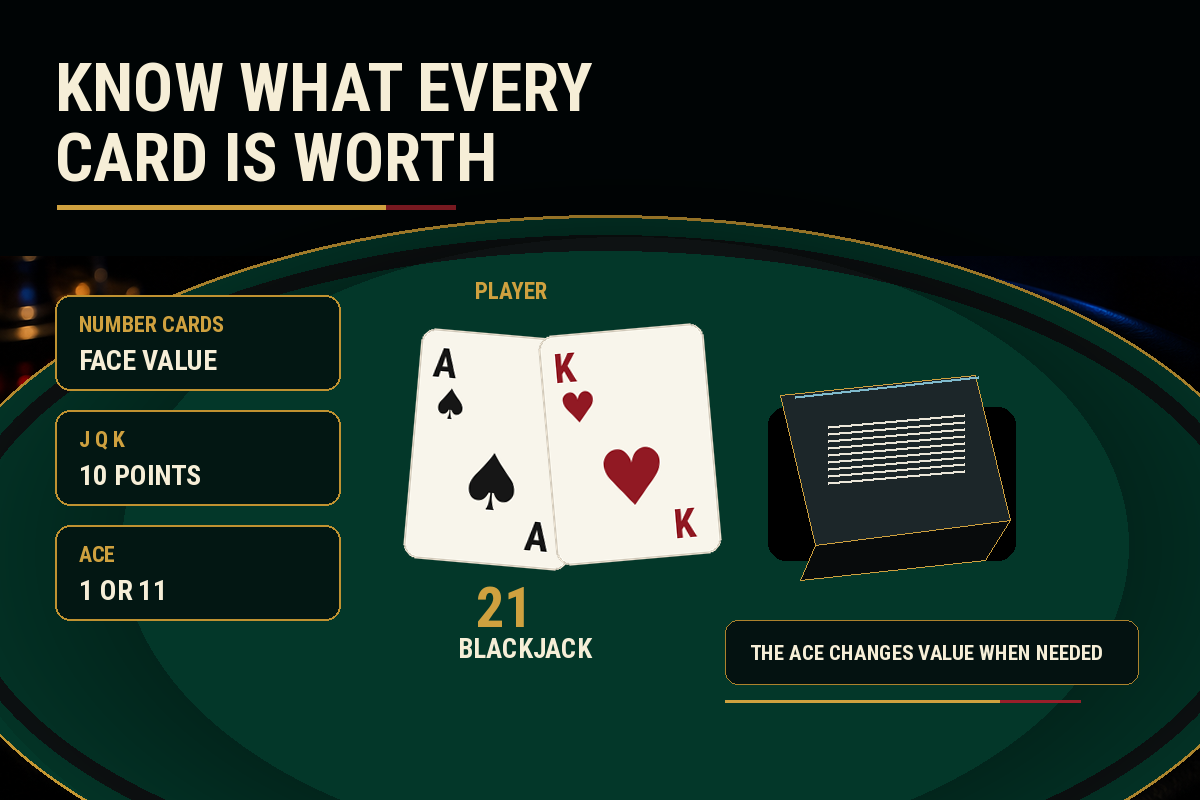
Blackjack card values are simple once you know three rules: number cards count at face value, Jacks, Queens and Kings count as 10, and an Ace can count as 1 or 11. Those rules determine blackjack hand values in standard play. The goal is to finish closer to 21 than the dealer without going over 21. On Gembet, the safest approach is to read the exact table rules before playing because card values are familiar across standard variants while dealer rules, payouts and available actions can differ.
Blackjack card values at a glance
| Card | Value | Important note |
|---|---|---|
| 2 to 9 | Face value | A 7 counts as 7 |
| 10 | 10 | Same value as a face card |
| Jack | 10 | Suit does not change the value |
| Queen | 10 | Suit does not change the value |
| King | 10 | Suit does not change the value |
| Ace | 1 or 11 | Uses the value that keeps the hand legal and most useful |
These blackjack card values make the arithmetic straightforward. A 7 and 9 total 16. A Queen and 6 also total 16 because the Queen counts as 10. Suits do not increase or reduce the point value, so a King of hearts and a King of clubs both contribute 10.
Why the Ace makes blackjack different
Among blackjack card values, the Ace is unique because it can count as 11 when that keeps the hand at 21 or below, or as 1 when 11 would cause a bust. This flexibility is why blackjack card values are not always fixed after the first deal.
For example, Ace plus 6 can be counted as 17, using the Ace as 11. If a 9 is drawn, treating the Ace as 11 would create 26, so the Ace instead counts as 1 and the hand becomes 16. The cards have not changed, but the usable total has.
Soft and hard totals explained
A soft blackjack hand contains an Ace that can still count as 11 without exceeding 21. Ace plus 7 is therefore a soft 18. A hard hand either contains no Ace or contains an Ace that must count as 1. Understanding this distinction is one of the most useful parts of blackjack card values because a soft blackjack hand has more flexibility when another card is drawn.
Consider Ace, 5 and 10. The Ace cannot stay at 11 because that would make 26. It counts as 1, producing a hard 16. By contrast, Ace and 5 alone can be treated as soft 16 because the Ace can still count as 11.
What counts as a natural blackjack?
With blackjack card values, a natural blackjack is normally the first two cards forming 21 with an Ace and any 10-value card. That means Ace plus 10, Jack, Queen or King. A three-card 21, such as 7 + 7 + 7, reaches the same numerical total but is not the same two-card blackjack combination.
This distinction matters because table rules can assign a special payout to a natural blackjack. The exact payout should be checked on the table rather than assumed. Blackjack card values explain why the hand totals 21, while the table rules determine how that result is paid.
Seven blackjack card values checks before a round
- Count number cards at face value. A 4 is worth 4 and a 9 is worth 9.
- Count every face card as 10. Jack, Queen and King have the same point value.
- Use the Ace as 1 or 11. Keep 11 only when it does not push the hand above 21.
- Separate a natural blackjack from any other 21. Two-card 21 can have different payout treatment.
- Know whether the hand is soft or hard. That affects how safely another card can change the total.
- Do not use card suits as point values. Hearts, diamonds, clubs and spades do not change the standard total.
- Check the exact table rules. Dealer actions and blackjack payouts can vary even when the blackjack card values stay familiar.
A simple hand calculation
Suppose you receive a 9 and a 5. Using standard blackjack card values, the total is 14. If you hit and receive a 6, the total becomes 20. If the next card were an 8 instead, the total would become 22 and the hand would bust.
With blackjack card values, the calculation is mechanical. The difficult part of blackjack is not adding the cards but deciding what action is allowed and appropriate under the specific table rules. Knowing the total prevents basic arithmetic errors before those decisions are made.
How multiple Aces are counted
Multiple Aces can look confusing, but blackjack card values still follow the same principle. Ace plus Ace is usually counted as 12, with one Ace at 11 and the other at 1. Counting both as 11 would produce 22, which is already over 21.
If a 9 is then added, Ace + Ace + 9 totals 21 by counting one Ace as 11 and the other as 1. If a King is added instead, the two Aces generally both count as 1, giving 12. The value of each Ace adjusts around the rest of the hand.
Blackjack uses totals, not poker hand rankings
Blackjack and poker both use playing cards, but they evaluate hands differently. Blackjack adds card values toward 21, while standard poker hands are ranked by categories such as pairs, straights, flushes and full houses. A suited combination does not become stronger in blackjack simply because all the cards share one suit.
For blackjack card values, the suit can usually be ignored when comparing blackjack hand values. An 8 of spades plus a Queen of hearts is still 18.
What does bust mean?
A hand busts when its total exceeds 21. If you have 10 + 7 and draw a 5, standard blackjack card values produce 22. The hand is over the limit and loses under normal blackjack rules, regardless of what the dealer later draws.
Aces can sometimes prevent an apparent bust by switching from 11 to 1. Ace + 7 + 8 would be 26 if the Ace stayed at 11, so it is instead counted as 1 and the hand becomes 16.
Dealer card values are calculated the same way
The dealer uses the same basic blackjack card values as the player. Number cards count at face value, face cards count as 10 and Aces can count as 1 or 11. What differs is how the dealer must act after the cards are dealt.
Blackjack card values do not determine dealer drawing rules. One table can require a stand on soft 17 while another requires a hit.
Why soft 17 needs a table-rule check
Soft 17 can be made with combinations such as Ace + 6. The total is 17 because the Ace counts as 11. Some tables instruct the dealer to stand on that total and others instruct the dealer to draw another card. The setting can affect how the round develops.
Do not infer the rule from blackjack card values alone. The cards tell you that Ace + 6 can equal 17. The table documentation tells you what the dealer must do with that 17.
Splitting does not change a card’s point value
When a table allows a pair to be split, the original two cards become the starts of separate hands and an additional wager is generally required. The blackjack card values themselves do not change. Two 8s still represent 16 before the split, and each new hand starts with an 8 after the split.
Split Aces often receive special treatment under blackjack rules. A 10-value card added to a split Ace can make 21, but some tables do not treat that result as a natural blackjack. Check the game rules before assuming identical payout treatment.
Check Gembet table information before relying on memory
Gembet’s live-casino in-game menu provides access to game rules, bet descriptions, special rules and RTP information. That is useful because blackjack card values are only one layer of the game. A table can differ in blackjack payout, dealer soft-17 behaviour, splitting conditions, doubling rules or side bets.
Use the table information as the final reference. A familiar layout or dealer presentation does not prove that every rule matches another blackjack table you have played.
Use blackjack card values as the foundation
The fastest way to read a blackjack hand is to add number cards at face value, count every Jack, Queen and King as 10, then decide whether each Ace should be 1 or 11. From there, identify whether the hand is soft, hard, a natural blackjack or over 21.
Blackjack card values make the arithmetic predictable even when the next card is not. They help you understand what your current hand is worth, but they cannot tell you which card will arrive next or guarantee a winning result.
Once blackjack card values become automatic, the table is easier to follow. Keep the card total separate from dealer rules, payouts and optional actions, check the current Gembet game information before wagering, and treat every undealt card as uncertain.
Experience the real deal with SG's top Live Dealers. Play Baccarat, Roulette & more.

