


Building Smarter Parlays with Sports Standings Betting Frameworks
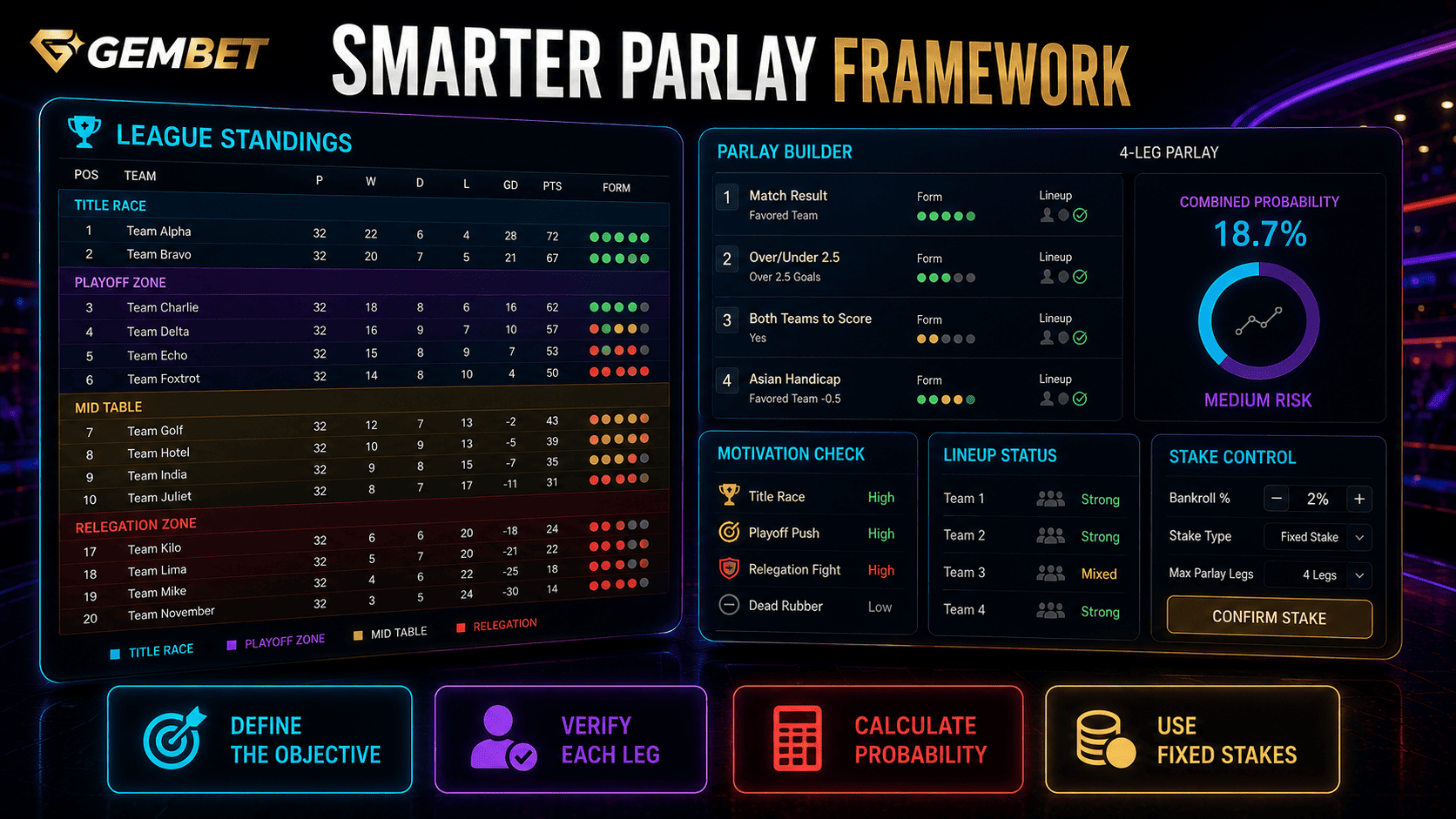
Betting frameworks can make parlay research more consistent, but they cannot turn a multi-leg ticket into reliable profit. Every added selection creates another condition that must succeed. Sports standings are most useful for identifying incentives, schedule pressure, and possible rotation before each leg is priced.
1. Start Betting Frameworks with Combined Probability
A multi-bet multiplies the risk of every selection. If four independent legs each have an estimated 70% chance of winning, the chance that all four succeed is about 24%, calculated as 0.70 × 0.70 × 0.70 × 0.70. That estimate can still be wrong, and bookmaker margin reduces the offered return.
Strong betting frameworks begin with the probability of the complete ticket, not the potential payout. Adding a short-priced favorite does not make a slip safer when that team’s true chance is lower than the market suggests.
2. Define Each Team’s Actual Objective
Sports standings show what is mathematically possible, but competition rules determine what a team needs. In the Premier League, the bottom three clubs are relegated, while teams level on points are separated first by goal difference. A draw, win, or margin can therefore have different value depending on the table.
For each leg, record the target, remaining matches, tiebreakers, and whether another result can change the situation. Betting frameworks should reject vague labels such as “must win” until the exact requirement is confirmed.
3. Screen Every Multi-Bet Leg Separately
| Question | Evidence | Reason to Pass |
|---|---|---|
| What result is needed? | Points, tiebreakers, other fixtures | A draw may be enough |
| Will the normal lineup start? | Official team news | Rotation remains uncertain |
| Is the schedule congested? | Travel and cup matches | Another match may be prioritized |
| Has the price moved? | Opening and current odds | The story may already be priced in |
Do not approve an entire ticket because most legs look reasonable. One weak selection can erase the value of the others.
4. Treat Motivation as a Hypothesis
A relegation-threatened team may play with urgency, but pressure can also create rushed decisions and defensive errors. A secure mid-table side may still compete for contracts, selection, rivalry, or a manager’s plans.
Betting frameworks should require lineup and tactical evidence. These betting frameworks cannot produce an accurate winner prediction from the table alone. Ask whether the market has already shortened the motivated side and whether the new price still exceeds your estimated probability.
5. Compare Handicap Markets Carefully
An underdog with a positive handicap can lose the match while the wager still wins, but the handicap is not automatically valuable. A relaxed favorite may still dominate, and an urgent underdog may concede early.
Before adding a handicap, estimate possible score margins. Check team strength, home advantage, injuries, expected lineup, and tactical matchup. Betting frameworks should never recommend +1.5 or +2 simply because one side appears more motivated.
6. Keep the Ticket Short and the Stake Fixed
Fewer legs do not guarantee success, but they reduce the number of conditions required. Three researched selections are easier to evaluate than ten loosely connected favorites.
Better process: fixed stake, limited legs, written reasoning, and a maximum weekly loss.
Higher-risk process: adding a leg to boost the payout or doubling after a losing ticket.
Betting frameworks should also account for correlation. Two selections from the same match or competition may be influenced by the same lineup news, weather, or tactical event. Do not assume the probabilities are independent.
7. Use In-Play Information Without Chasing
Live events can change incentives, but prices adjust quickly. A team that concedes may attack more, yet that does not automatically make an over bet valuable. Red cards, fatigue, time remaining, substitutions, and the current price all matter.
Never add an in-play wager merely to rescue a failing ticket. The UK Gambling Commission notes that cash-out availability can be withdrawn and may be difficult for bets containing multiple selections. Treat cash out as optional, not guaranteed.
Betting Frameworks: Myth Versus Reality
Myth: Low odds create a safe parlay leg.
Reality: Favorites still fail.
Myth: The team with more motivation will perform better.
Reality: Ability, tactics, availability, and chance remain decisive.
Myth: More legs create better value.
Reality: More outcomes must be correct.
Best Way to Apply Betting Frameworks
The best betting frameworks use sports standings as a research filter rather than an automatic selection tool. Define the objective, verify the rules and lineup, calculate the ticket probability, compare the price, and remove any leg supported mainly by narrative.
For Gembet SG users, local legality must be checked separately from analysis. Singapore’s Gambling Regulatory Authority states that Singapore Pools is the only operator licensed to provide remote gambling services locally. Keep every multi-bet within a fixed entertainment budget. Betting frameworks are strongest when they help you pass on a weak ticket instead of forcing action.
Experience the real deal with SG's top Live Dealers. Play Baccarat, Roulette & more.

