


Baccarat Rules and How Every Hand Is Decided
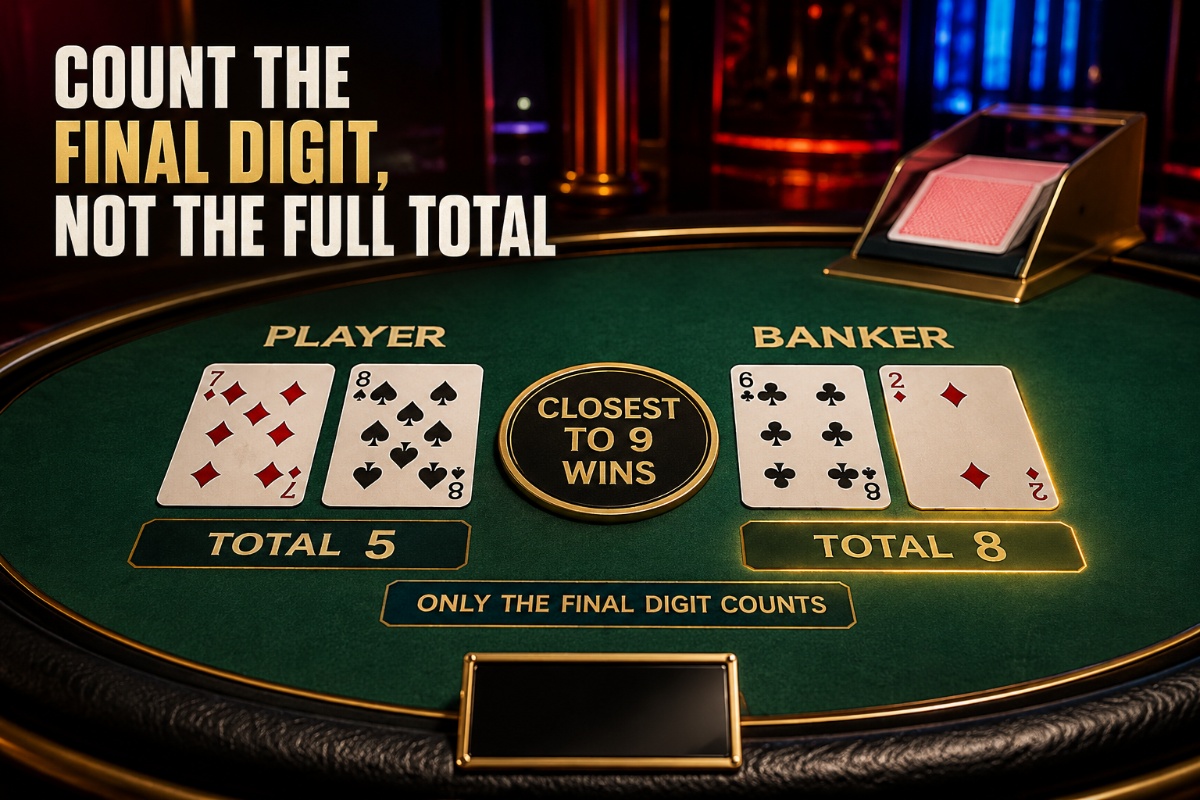
Baccarat rules are easier to understand when the game is separated into three stages: choosing a wager, calculating the hand totals, and applying the compulsory drawing procedure. Players normally back Player, Banker, or Tie. They do not decide whether either hand receives another card. The hand finishing closest to 9 wins, while the exact payout depends on the selected wager and table version.
Baccarat rules at a glance
| Rule | What it means |
|---|---|
| Main wagers | Player, Banker, or Tie |
| Card values | Ace is 1; cards 2–9 use face value; tens and picture cards are 0 |
| Hand total | Only the final digit counts |
| Winning hand | The total closest to 9 |
| Drawing decisions | Applied automatically under the game rules |
Start with Player, Banker, and Tie
The main betting areas are named after the two hands rather than the people at the table. A Player wager backs the Player hand. A Banker wager backs the Banker hand. A Tie wager predicts that the two final totals will be equal.
Choosing Banker does not mean acting as the casino or dealing the cards. Player and Banker are simply the labels used to identify the two competing hands.
How baccarat card values work
Baccarat rules assign straightforward point values:
- Aces count as 1.
- Cards from 2 through 9 use their printed value.
- Tens, Jacks, Queens, and Kings count as 0.
Suits do not affect the ordinary hand total. A King of hearts and a King of clubs both contribute zero points.
Only the final digit counts
When two or three cards add to 10 or more, the tens digit is ignored. A 7 and an 8 total 15, so the baccarat hand value is 5:
7 + 8 = 15 → hand value 5
A 9, 6, and King also produce a hand value of 5 because the King contributes zero. This final-digit method keeps every total between 0 and 9.
Natural 8 and natural 9
A two-card total of 8 or 9 is called a natural. Under standard baccarat rules, a natural normally stops further drawing for both hands.
If Player has 8 and Banker has 7, Player wins. If both hands have 9, the round is a Tie. The term natural applies only to a total reached with the first two cards.
The Player hand is checked first
After the opening deal, the Player hand is reviewed before Banker. Under the common drawing procedure:
- Player draws on totals from 0 through 5.
- Player stands on 6 or 7.
- No further card is drawn when either hand has a natural 8 or 9.
These actions are compulsory. A person who backed Player cannot request another card or decide to stand.
Why the Banker drawing table looks more complex
Baccarat rules for Banker depend on the Banker total and, in some cases, the value of Player’s third card. If Player stands, Banker generally draws on totals from 0 through 5 and stands on 6 or 7.
If Player draws, Banker follows a fixed table. Banker normally draws on 0, 1, and 2 regardless of Player’s third card. Other Banker totals use narrower conditions.
The dealer or software applies this procedure automatically. The table does not make a discretionary strategy decision.
A practical Banker drawing summary
| Banker total | Typical action when Player draws |
|---|---|
| 0–2 | Draw |
| 3 | Draw unless Player’s third card is 8 |
| 4 | Draw when Player’s third card is 2–7 |
| 5 | Draw when Player’s third card is 4–7 |
| 6 | Draw when Player’s third card is 6 or 7 |
| 7 | Stand |
This reflects the widely used standard table. The help panel for the active version remains the final reference.
How the winning hand is decided
Once all required cards have been dealt, the totals are compared. The hand closer to 9 wins. There is no bust rule and no requirement to reach a dealer threshold such as 17.
A total of 2 loses to 4, while 8 beats 7. When the two sides finish with the same value, the result is recorded as a Tie.
Standard Player and Banker payouts
Traditional commission baccarat commonly pays a successful Player wager at 1:1. A winning Banker wager commonly pays 0.95:1 after a 5% commission.
For a S$20 winning Player wager:
S$20 stake + S$20 profit = S$40 total return
For a S$20 winning Banker wager with 5% commission:
S$20 stake + S$19 profit = S$39 total return
The Gambling Regulatory Authority of Singapore’s approved baccarat rules publish Player at 1:1 and Banker at 0.95:1 for the cited standard version.
No-commission baccarat changes a payout condition
No-commission baccarat usually removes the routine 5% deduction but introduces a reduced payout for a particular Banker result. A common version pays most Banker wins at 1:1 but pays only 0.5:1 when Banker wins with 6.
The phrase “no commission” therefore does not mean that every Banker result receives full even money. The exact Banker-6 treatment must be checked in the current paytable.
What happens on a Tie
Under common baccarat rules, a Tie returns the ordinary Player and Banker stakes rather than settling either as a loss. A separate Tie wager wins according to its own displayed payout.
Suppose S$10 is placed on Player and the final totals are both 6. The S$10 Player stake is normally returned, but it does not earn a 1:1 profit.
Variants can use different Tie prices, so the active table remains the final source.
Pair bets use the opening cards
Player Pair and Banker Pair are separate optional wagers. A pair normally requires the first two cards of the named hand to share the same rank.
A Banker Pair can win even when Player wins the main round. The pair result and the winning hand are settled independently.
This opening-card pair rule means a later third card cannot create a Pair win.
Side bets do not change the drawing procedure
Bonus wagers may use pairs, winning margins, specific totals, Banker winning with 6, or other defined events. They can make the layout look complex, but the main Player and Banker hands still follow the published drawing procedure.
Each optional market adds another stake. A S$10 Banker wager with two S$2 side bets creates:
S$10 + S$2 + S$2 = S$14 opening exposure
Roadmaps record completed hands
Live baccarat often displays a Bead Plate, Big Road, and derived roads. These charts organise previous Banker, Player, and Tie results.
They do not participate in dealing cards or applying baccarat rules. A Banker streak does not force another Banker result, and a long absence of Player does not make Player due.
Use the roadmap to review history rather than to claim certainty about the next hand.
Roadmaps and commission track different details
A Big Road normally marks a Banker win the same way whether the hand finished with 6, 7, 8, or 9. It records the winning side, not the exact profit returned.
The transaction history is more useful for checking commission, side-bet settlement, and the accepted stake. Keep the complete table title and round reference when a result needs review.
Live and RNG versions can share the same objective
Live tables stream physical cards and a dealer-operated shoe. RNG versions generate and settle rounds through software. Electronic table games can combine a shared physical result with individual betting terminals.
The presentation changes, but the goal can remain identical: back the hand that finishes closest to 9. Compare the drawing table, payouts, side bets, speed, and limits rather than assuming that every format uses identical baccarat rules.
Table speed changes total turnover
A fast table completes more betting opportunities during the same period. At S$5 per round:
20 rounds = S$100 total wagered
60 rounds = S$300 total wagered
These figures show turnover, not predicted losses. Faster play does not change the next cards, but it increases the number of accepted wagers.
Common rule mistakes to avoid
- Treating picture cards as 10 instead of 0
- Keeping the full total instead of only the final digit
- Believing the bettor decides whether to draw
- Assuming every Banker win pays 1:1
- Confusing a Tie wager with a push on the main bets
- Treating roadmap patterns as guaranteed forecasts
A short third-card procedure check resolves most confusion before the betting timer closes.
Moving between slots and baccarat
Readers comparing different casino formats may also use the earlier guide on slot paylines explained. Slots determine prizes through eligible symbol paths or other reel mechanics, while baccarat uses fixed hand values and compulsory card-drawing rules. In both cases, the active instructions matter more than assumptions based on the visual layout.
Checking baccarat rules on Gembet
When comparing baccarat tables on Gembet, use the complete current title and information panel. Providers may offer commission, no-commission, speed, squeeze, electronic, or bonus-enhanced versions.
- Confirm the card values and final-digit scoring.
- Check the Player and Banker drawing procedure.
- Read the Player, Banker, and Tie payouts.
- Identify commission or reduced Banker-win conditions.
- Separate pair and bonus wagers from the main bets.
- Check table minimums and side-bet limits.
- Review the round speed and accepted wager total.
- Use the result history for settlement questions.
Baccarat rules as a practical table guide
Baccarat rules do not require hit, stand, split, or fold decisions. The player chooses a betting area, and the cards are handled under a compulsory procedure.
Remember the opening-card pair rule for pair wagers and complete a third-card procedure check when a draw looks unfamiliar. Then compare commission, Tie treatment, side bets, and limits for the exact version.
Baccarat rules become straightforward once card values, final-digit scoring, natural hands, and automatic drawing are separated from the optional wagers surrounding the main game.
Experience the real deal with SG's top Live Dealers. Play Baccarat, Roulette & more.

